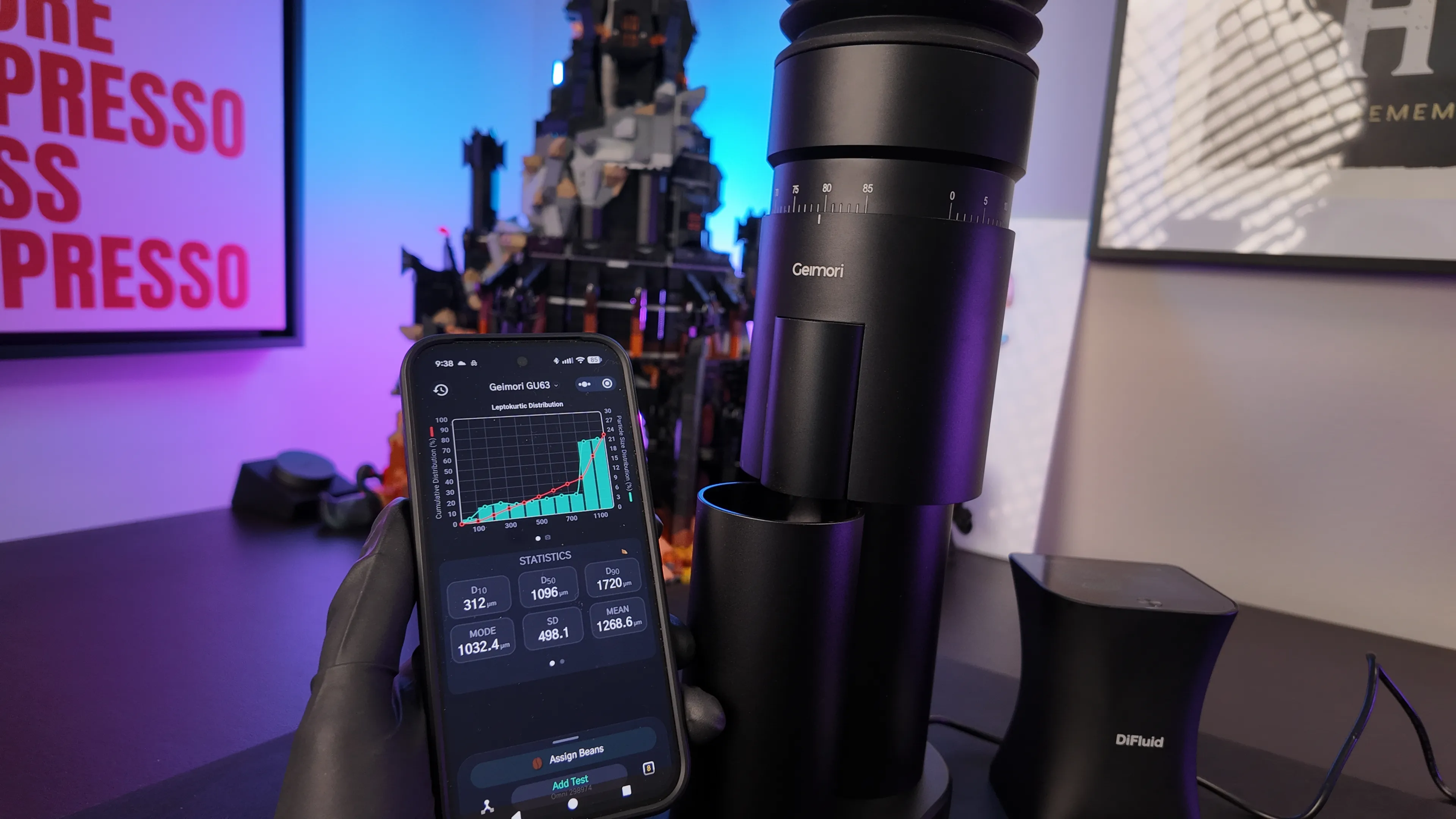
Geimori GU63 Review and Grind Chart
Impressive consistency at espresso ranges and reduced fines in pour-over makes this a great dual-use grinder.
Grind data is captured via DiFluid Omni NIR analysis. I plot the particle distribution across 16+ settings to identify the 'Optimal Zone' for each brew method. Actual results vary based on roast type and freshness, among others; however, it remains a starting point for dialing in.
This site is 100% ad-free and always will be. This particular review was conducted on a factory-new, calibrated unit, and was not sponsored. I purchased this unit for testing purposes. Purchases made through our links may earn a commission, supporting the testing and data acquisition.
Full Review and Benchmark Test
It’s starting to feel like we’ve entered a golden age of affordable grinders.
Hot on the heels of the $200 Fellow Opus 2’s May release, relative newcomer Wirsh released the Geimuri GU63 in June.
The GU63 looks like a cross between an Opus and a Df64, and it seems like Wirsh has positioned it to compete in the same arena as both grinders, right down to adopting the same naming convention as the Df64 and Df54.
The GU63 is currently priced at $259.99, and where it stands apart at this price range is its massive 63mm conical burrs.
Wirsh’s flagship is a $399 flat burr grinder called the GU64 that they funded through a 2024 kickstarter. Since then, they’ve released the compact 38mm conical burr grinder, the GU38, the portable T38, and today’s focus, the GU63.
Within a couple of years, Wirsh has seemingly built a grinder in its Geimuri range for everyone, with every single model coming in at less than $400.
So where’s the catch? Does the GU63’s performance line up with its specs? And if so, is it able to blow the competition out of the water in this price range? Let’s find out!
Features
- 63mm stainless steel conical burrs
- Plasma anti-static system
- Stepless grind adjustment
- (A nice touch) an included RDT spray bottle
Unboxing
The GU63 ships in a plain brown cardboard box containing a simple black outline of the unit on the front and not much else. It’s a design language that wouldn’t look out of place on a Fellow or a Timemore product.
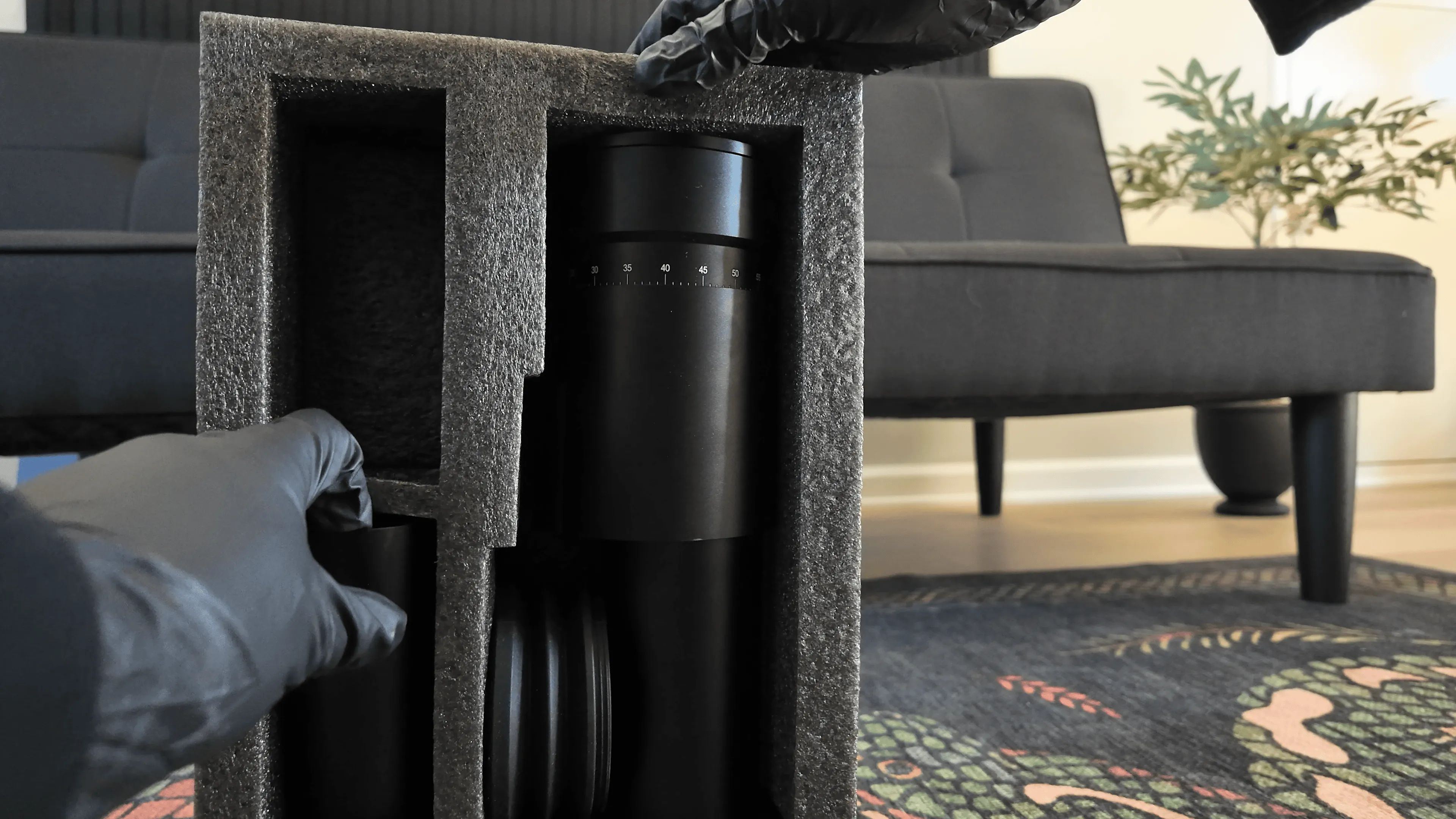
The parts inside are stored in the cheap-feeling, grey packing foam you typically see in products out of China (Wirsh is headquartered in New York, with manufacturing based in China).
Inside is the machine itself, a bellows, a magnetic catch cup, the power cable, a cleaning brush, and finally, even though you can buy one on Amazon for a few bucks, the inclusion of a small RDT bottle feels like a really nice touch.
The packaging it comes in may feel cheap, but the grinder certainly does not. The anodized aluminum exterior makes the GU63 feel heavy in your hand, and once it’s out of the box, you’ll be eager to run the first dose through it.
Design
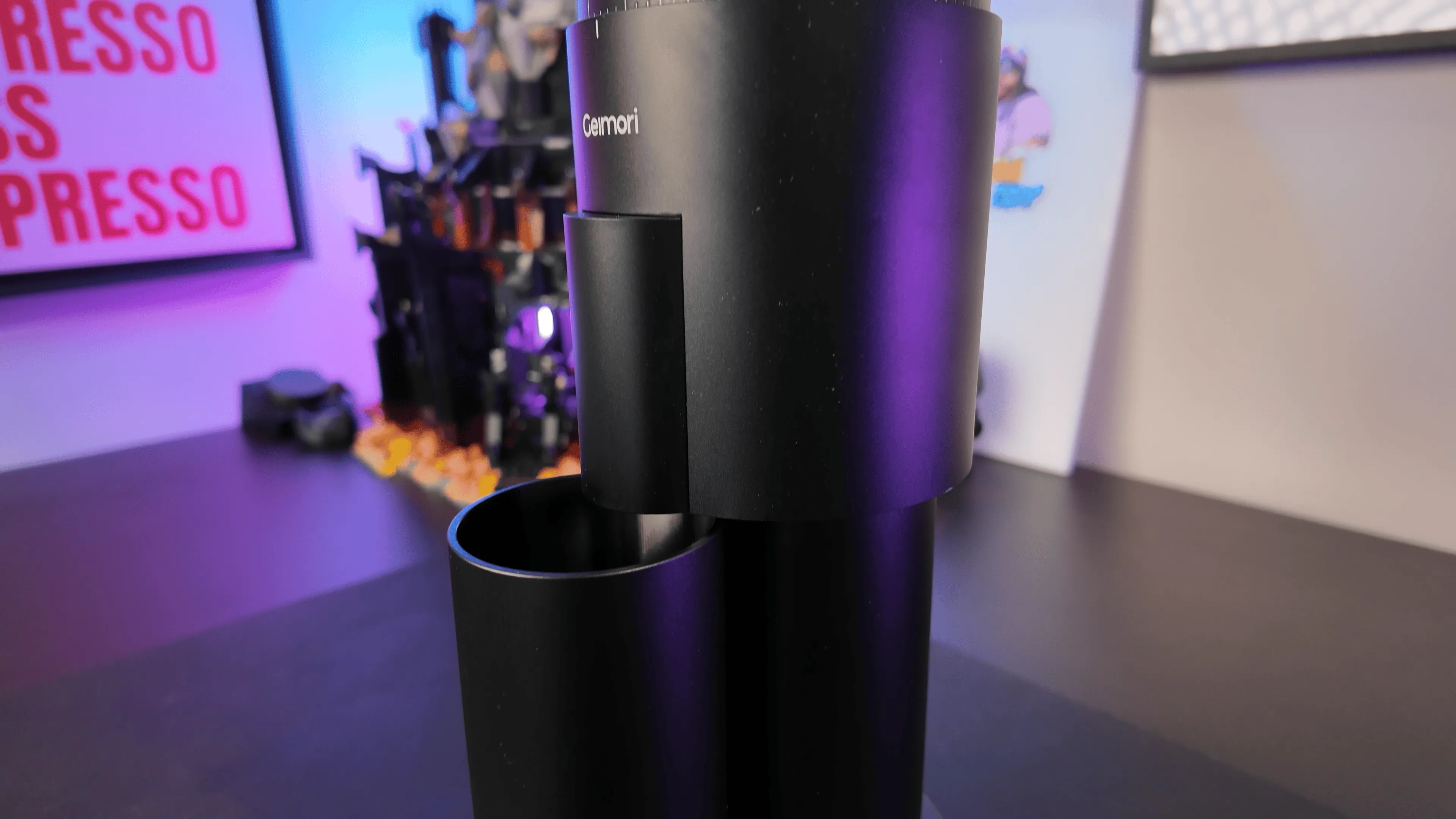
The GU63 barely puts a foot out of place in the design department. Its clean lines and frankly unexpectedly high build quality for the price mean it won’t look out of place next to nearly any espresso machine.
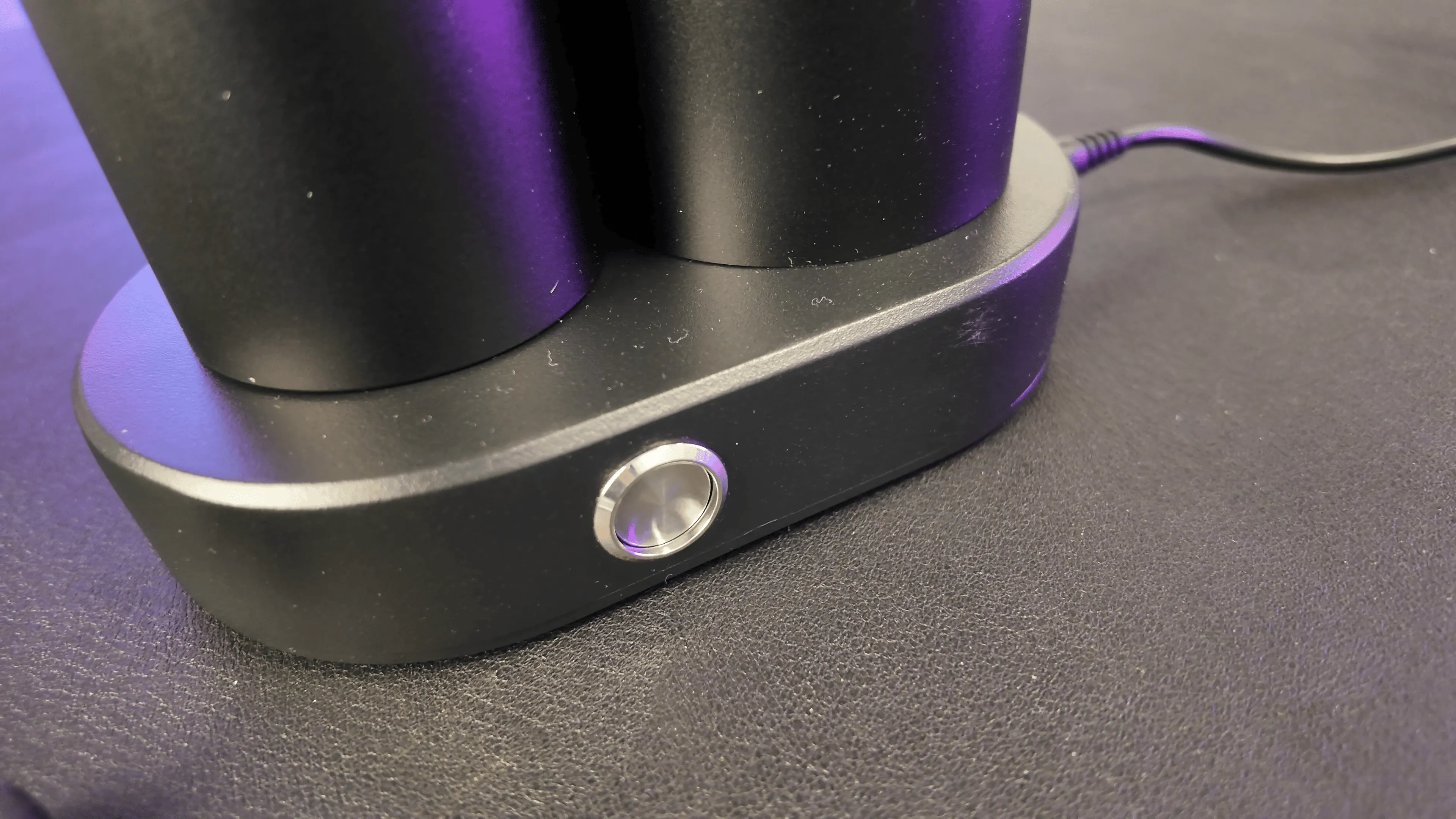
The controls are simple and minimal, rotate the collar to adjust the grind setting (a movement that feels fluid and solid), and hit the on/off button on the side to start the motor. Maybe I’m a bit weird, but I absolutely love a tactile button like this; it clicks inward and locks in place, giving a way better feel than the plastic button on the Fellow Opus.
Unlike the Df64 which has a slight forward lean to allow for beans to pass through its flat burr grind path, the GU63 stands completely vertically. This owes to the fact the GU63 has conical burrs, and grinds are dropping directly into the catch cup from the burrs above.
This has the added advantage of contributing to an impressively small footprint.
The GU63 is just over a foot tall and you can add a couple of inches to that if you plan on using the included bellows (which you will need, we’ll get into this in the performance section).
How much the appearance of the bellows bugs you is up to each user, but there’s no arguing that the whole thing loses some sleekness as soon as they’re on. On the other hand, it’s a small price to pay for reducing retention.
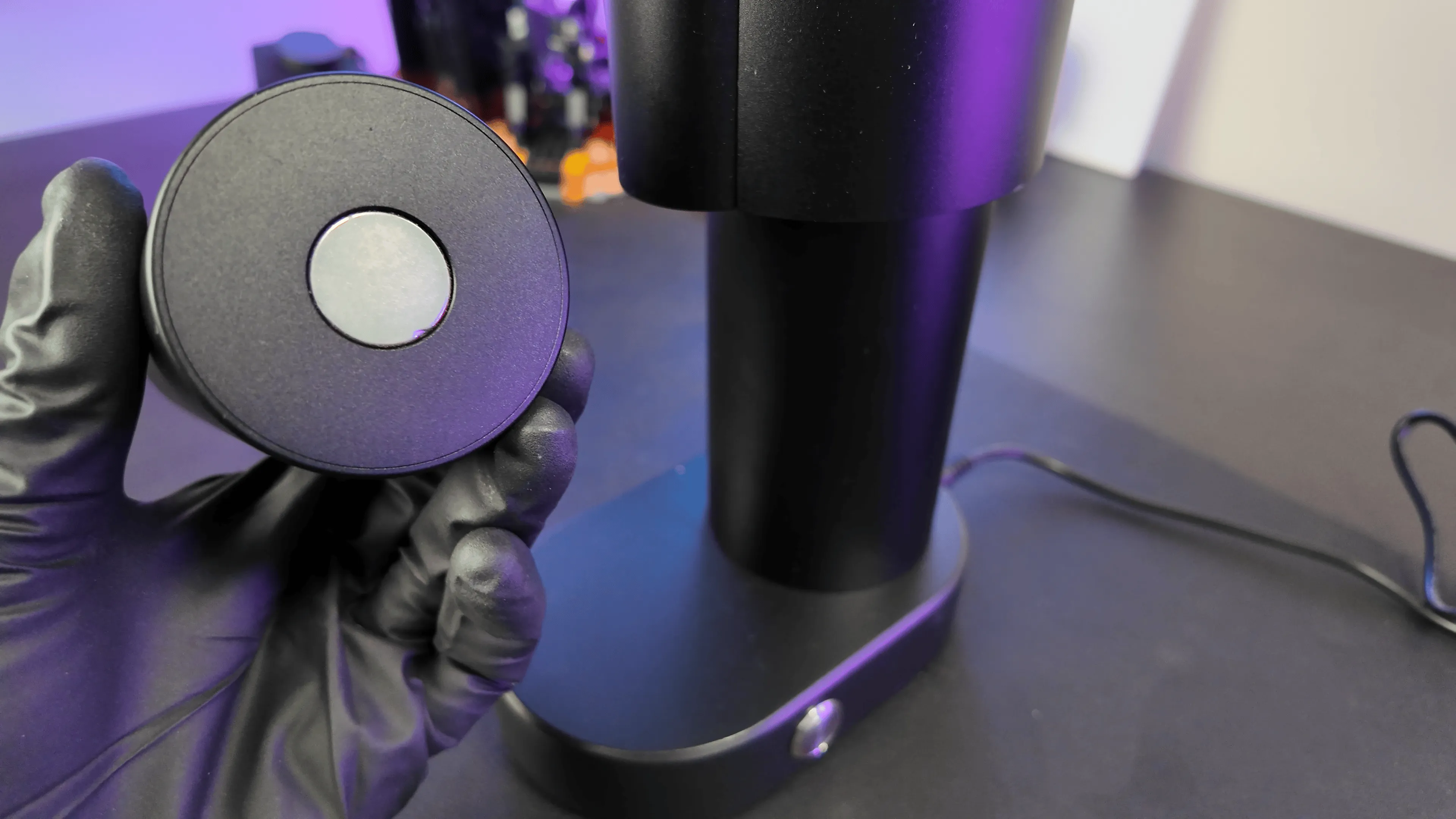
One of the more satisfying elements of the GU63 is the 58mm magnetic catch cup, which crisply slides into place whenever you’re done with it.
A magnetic catch cup is nothing new, but it’s emblematic of the rest of the grinder’s design. Everything works together to make a pleasant grinding workflow that you’ll look forward to using.
Burrs & Calibration
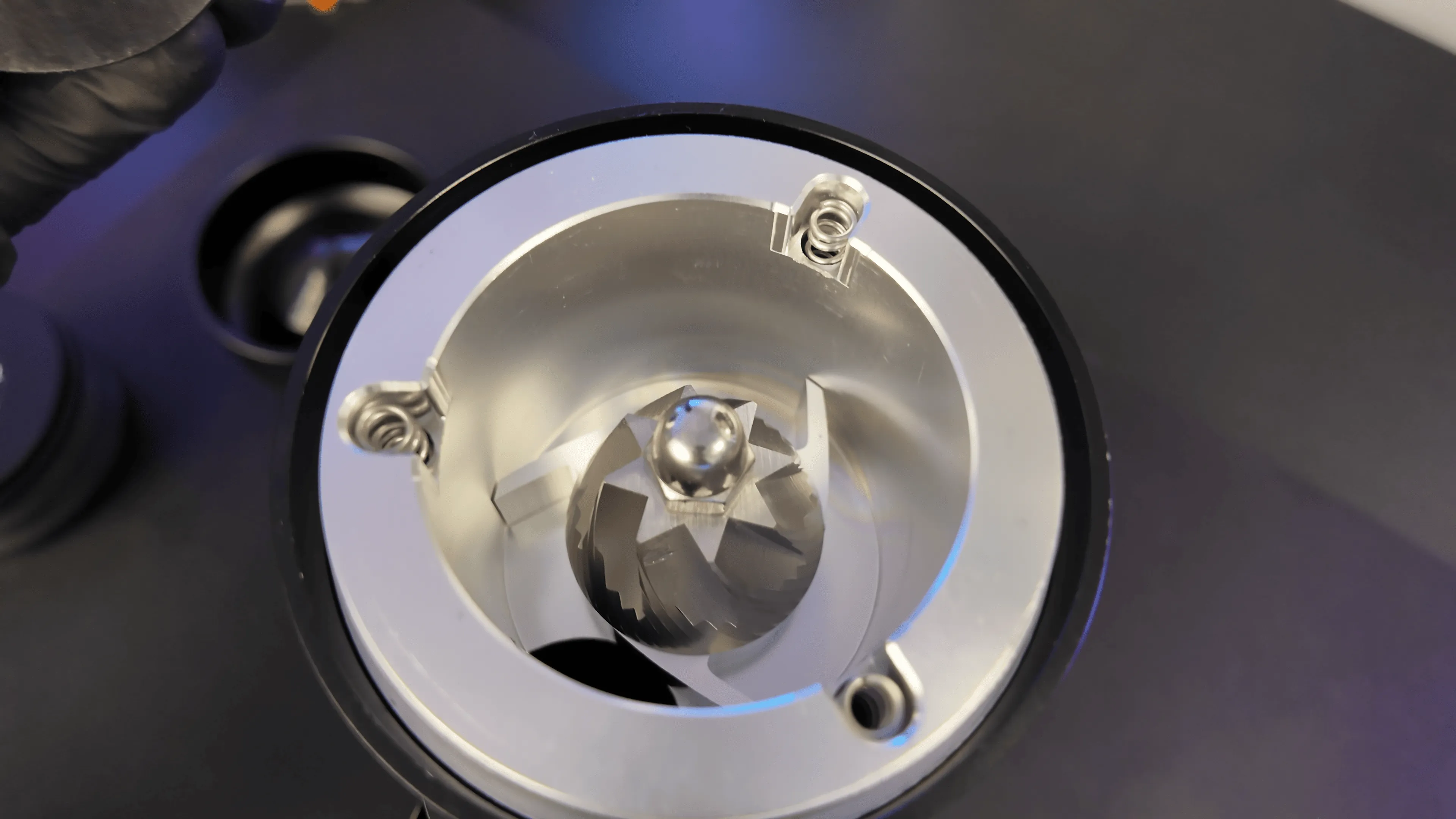
The GU63 gets its name from its aforementioned 63mm stainless steel burrs.
The burrs are octagonal, with a geometry that’s designed to reduce fines. Each side starts with a single cutting blade at the top of the burr which gives way to a curved series of fine cutting blades.
Maybe the most interesting thing about the burrs, however, has to do with the speed at which they spin.
The GU63 runs at 80 rpm. At that speed, less heat builds up during grinding, and fewer fines are produced, as fewer particles are forced back up into the burrs and re-ground. In theory, that means more clarity in your pour over, and less muddiness in your espresso (whether you’re after that or not). And in practice, I tested the consistency difference in variable RPM while reviewing the Gevi VelPro 400 and recorded a 2.4% decrease in fines by using 500 RPM vs 1500 RPM. So there’s really no doubt in my mind the GU63 at a much lower RPM will produce even less fines.
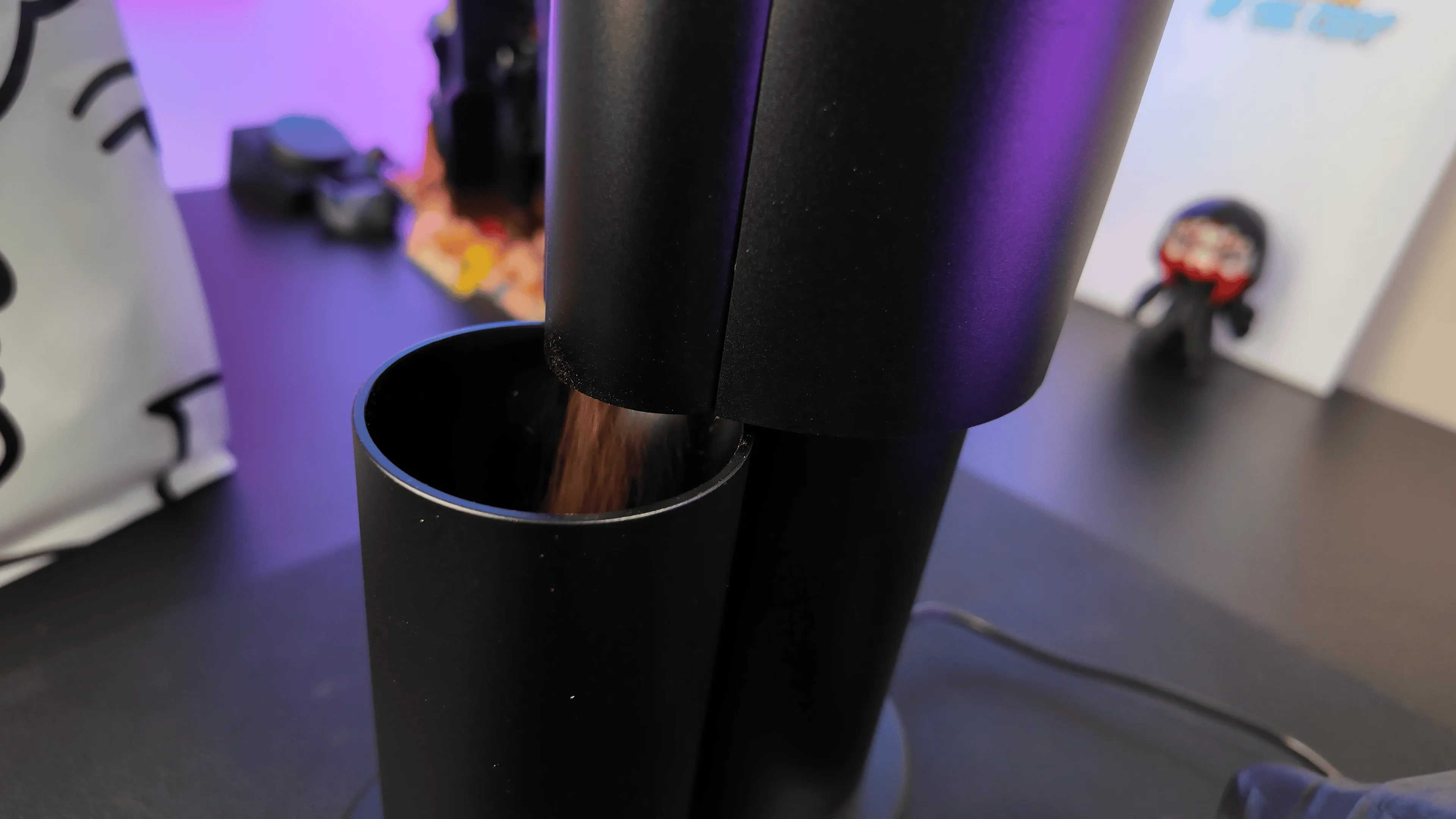
The size of the burrs helps make up for the reduction in speed, but at 30 seconds for an 18g dose, it’s nowhere near the speed demon that is the Opus 2.
The grind adjustment can be easily removed by rotating it clockwise to get at the burrs, with the outer burr sliding out without much resistance.
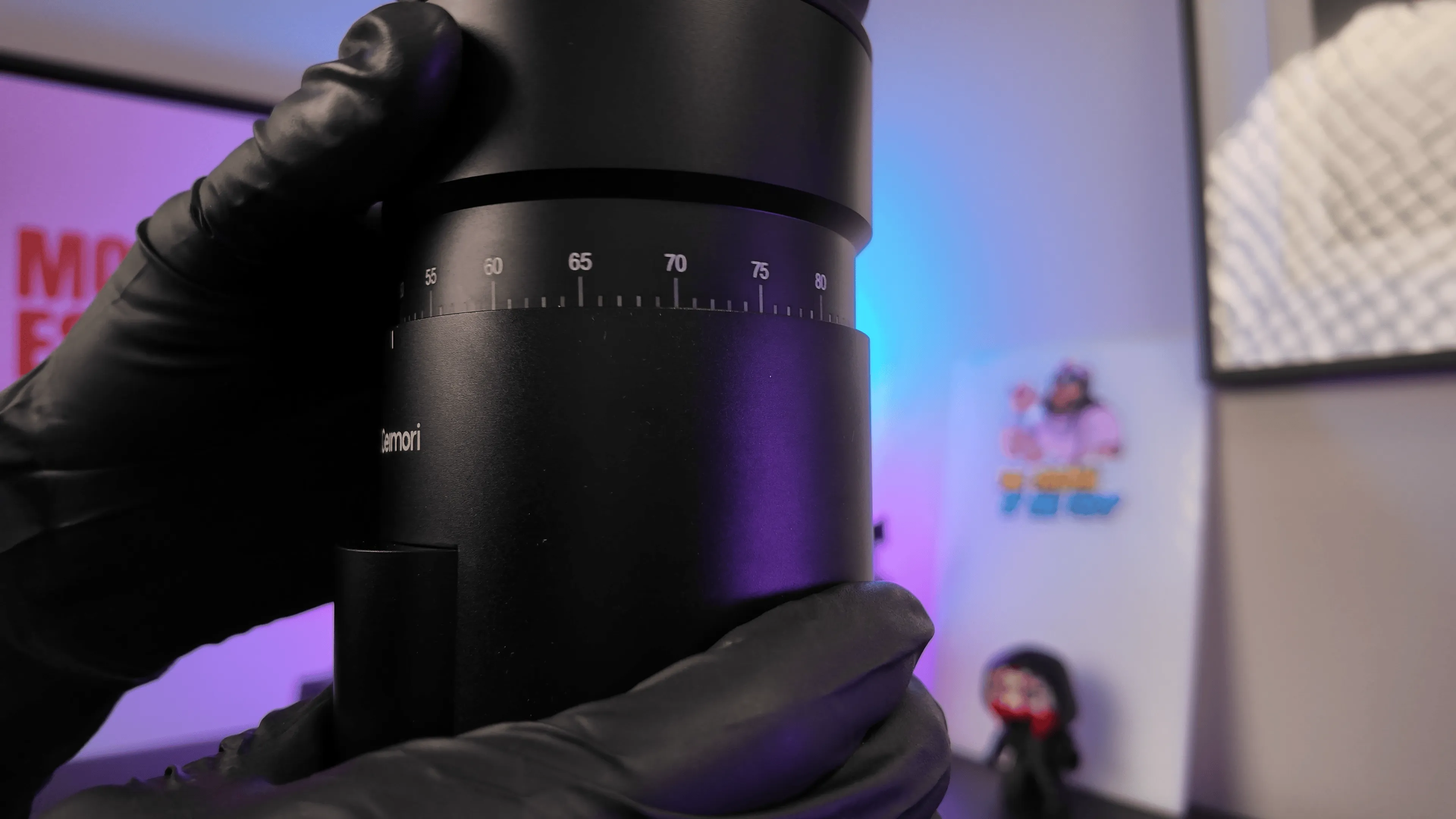
Calibration is interesting. Their guide mentions to rotate the grinder counterclockwise until the burrs lightly touch, before moving the adjustment back to zero. This isn’t actually adjusting anything. By setting it to zero every time, you’re not actually calibrating. You’ll instead need to go by sound when you hear them touching (ie, your reference point). You may hear that 5 ticks below zero, whereas I might at 3, etc.
Performance
Retention
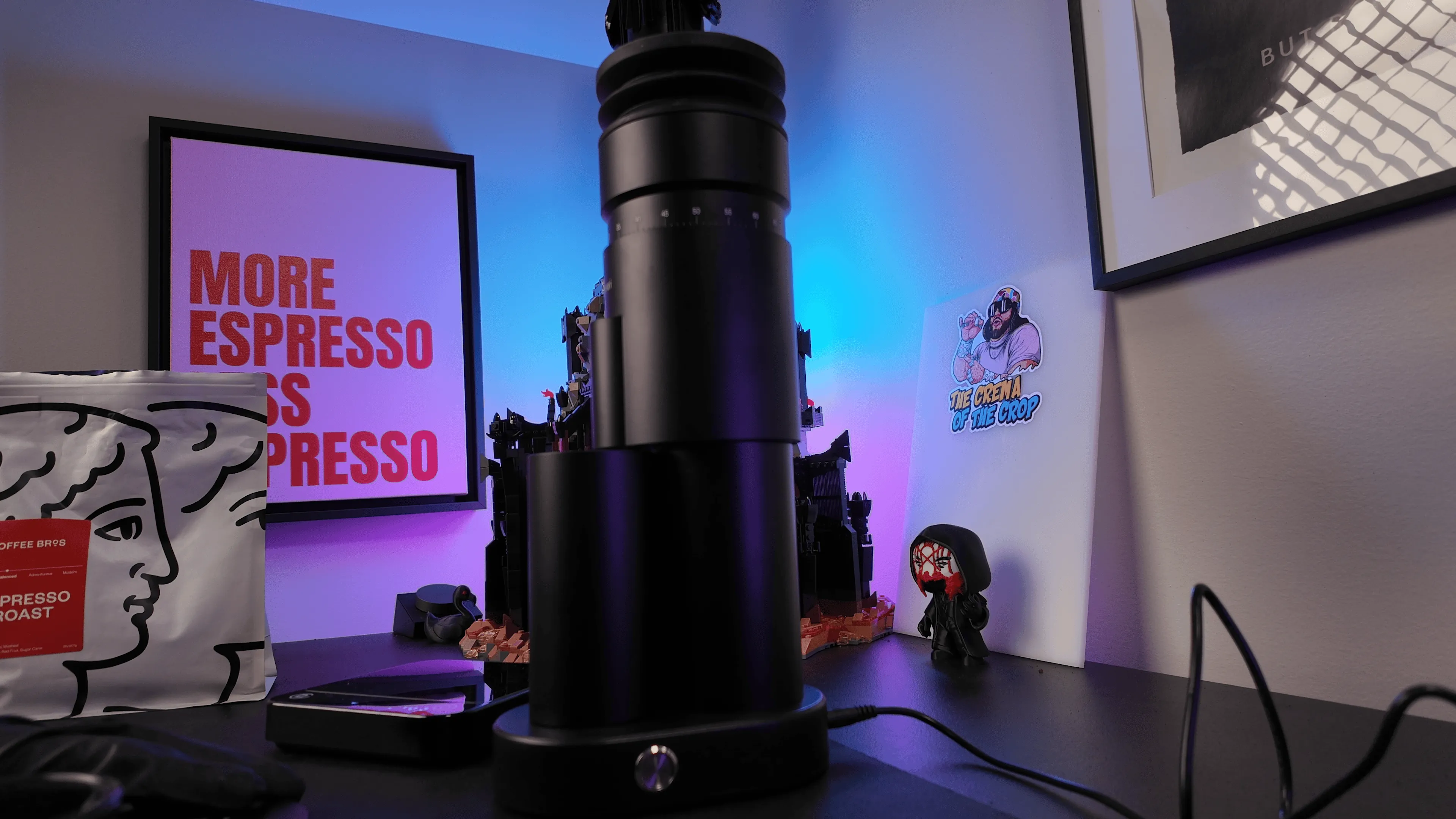
I always run the particle analysis and use it as a daily driver for a bit before cleaning it out to run my official retention tests. That way, I’m consistently conducting the tests on a dialed-in grind setting. But after getting this setup, I saw the manufacturer recommended settings of 5-20 for espresso and got a bit antsy. I set it to 15 and started grinding.
The motor actually bogged down while grinding, which was my first clue it was too fine. Then I witnessed a disgusting 3 and a half grams retained (before using the bellows; after bellows I was able to get it to 0.2g under). But let’s not panic; this was way too-fine of a grind. I couldn’t get a drop of water to pass through the puck.
After finding my dial-in point right around the 30 mark, I ran another dry 18 gram dose…..and it wasn’t much better. The bellows is 100% part of this design. If you use the bellow with the power off, you might still struggle to get the full amount out. But if you leave the grinder running and then use a few firm pushes, I get the full 18 grams out.
And here’s one more tip when using the bellows: use one full, single push at a time. If you do two quick consecutive pushes, the tall cylindrical catch cup produces an upward gust of air that makes more of a mess. But if you pause for a second between pushes, that doesn’t happen.
Particle size distribution
After running 70 tests on my DiFluid Omni particle analyzer, I found an excellent overall repeatability of 5.4%. At the time of this review, the average across all grinders tested (manual and electric) is a 6.9% repeatability. My repeatability measurement is a coefficient of variation which looks at how consistent of a mean particle distribution you can expect from dose to dose.
Now, some grinders do better in certain particle sizes than others, so instead of only measuring repeatability ratings across the full tested spectrum of grind sizes, I started to piece it out into espresso and pour over ranges as well. This gives us a better direct comparison between grinder models and what area they perform best at. Looking at this new data, we can see the new Fellow Opus 2 slightly outperformed the GU63 by 0.4%, but widely beat the similarly priced original Opus and Baratza Encore ESP.
Moving over into pour over territory, the GU63 performed the best in this conical burr comparison, which means it could be a solid option for those who primarily want espresso but occasionally want a pour over.
GU63 - Electric
- Fellow Opus 2
- Geimori GU63
Overall Between-Run SD
Averaged across repeat-run settings in the active range. Lower is more consistent.
Overall averages are dynamically clipped to a shared grind range (D50 ≤ 1133µm) so every grinder is judged on the same particle sizes — a fair, apples-to-apples comparison. For the complete, unclipped performance data, read the full reviews: Fellow Opus 2, Geimori GU63.
I also started looking at the percentage of fines generated at each grind setting, tested with the same beans. Comparing this to the Opus 2, and as expected, the GU63 produced less fines across the board - except at my dial in point for espresso.
Fines Generation vs Grind Size
Every grinder on one axis: median particle size (D50) against the percentage of fines below 300µm. Lower is cleaner at the same grind size.
Fines are the share of each scan's particle distribution below 300µm, averaged across every run at that dial setting. Benchmark values are the mean of the interpolated fines curve across each brew range (Espresso 350–500µm, Pour Over 600–850µm), using only the portion of the range a grinder was actually measured across.
Sound
I’ve read a few other reviews reporting a 65dB sound level. During my tests, I recorded an average of around 59dB with the motor running without beans, but 75.5 dB when grinding beans. Comparatively, and a bit surprisingly, this is right on par with the Fellow Opus. So the smaller motor doesn’t exactly result in much of a noise reduction. But either way, this isn’t a loud machine; the Baratza Encore ESP is much louder with a max dB reading of 88.2.
Final verdict
Overall this is a really interesting contender for beginners. There’s not many options at this price point with burrs of this size. With the combo of larger burrs and a smaller motor working at a much lower RPM, I thought the percentage of fines would be quite a bit lower that what I recorded. They still came in lower than the Opus 2, but the speed of that machine is insane in comparison. So the reduced fines taking much longer to grind is just a price to pay.
More time will tell on the longevity. The lower-powered motor can definitely reach a struggle point if you go too fine, which can’t be good for the long-term health of it.
But the most interesting thing I notice when looking at the data is the solid performance in the filter range. While it’s still ideal for espresso, this could be a go-to choice for primary espresso drinkers who occasionally want an easily adjusted grinder for pour overs.
Technical Specifications
| Brand | Geimori |
|---|---|
| Model | GU63 |
| Adjustment | Stepless |
Common Questions
- What’s the benefit of the GU63’s 63mm conical burrs?
- Bigger burrs mean your dose is being ground across more surface area, which, in theory, means a better particle distribution with fewer fines. A grinder’s performance involves a whole lot more than burr size, but as you move towards prosumer and commercial machines (which tend to be flat burrs rather than conical), burr size tends to enter the 60 - 100mm range.
- What’s the benefit of grinding at a lower RPM?
- Grinding at a lower RPM has two benefits. The first is that the lower speed exposes your beans to less heat before brewing. The second is that beans can enter the burrs at a more controlled rate, reducing regrinding and fines in the process.
- Who is each Geimuri grinder geared towards?
- Geimuri’s flagship grinder, the GU64, is a $399 64mm flat burr grinder aimed at pour-over or specialty espresso drinkers who favor high clarity and sweet acidic notes. The GU63 offers 63mm conical burrs at $259, giving traditional espresso drinkers a more affordable option to something like the Niche Zero. The GU38 is a budget-focused compact grinder with 38mm conical burrs for $179, while the portable T38 is a $149 budget option designed to fit within a travel case.